
Physical AI, Shelf Intelligence, and IKEA’s Reverse Engineering Playbook
Every week, we distill industry podcasts and conferences into what you need to know.
In today's issue:
Physical AI is how retailers will avoid getting disintermediated by the hyperscalers
Walmart’s 100,000 electronic shelf labels per store is creating the infrastructure AI actually needs
Lessons from IKEA’s “price first” product design
1. Physical AI is how retailers will avoid getting disintermediated by the hyperscalers
Omni Talk Retail with David McIntosh, Chief Connected Stores Officer at Instacart: How Instacart Is Using Physical AI to Rebuild the In-Store Experience (Jan 12, 2026)
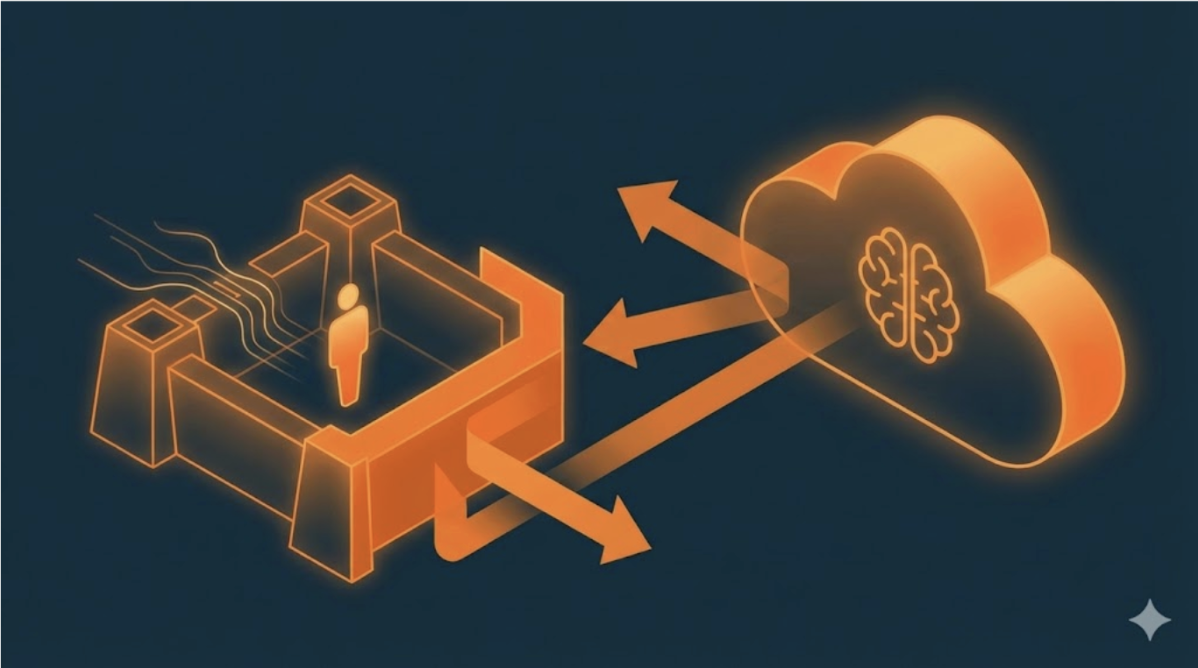
Background: Retailer boards are demanding real AI strategies – not next year, but this quarter. Instacart's David McIntosh’s answer: the retailers who win the next decade will be those who invest in physical AI – AI that runs inside the store at the edge – not just cloud-based LLMs. Why? Because Gemini, OpenAI, and Anthropic aren't putting hardware in your stores. They're not capturing dwell time, clickstream data on carts, or real-time shelf availability. The retailers who own that physical data will own the customer relationship.
TLDR:
Invest in physical AI running at the edge (not just cloud LLMs) to build proprietary customer understanding that hyperscalers can't replicate: Instacart uses NVIDIA Jetson boards in every Caper cart to process data in real time where Wi-Fi is spotty.
Connected store technology is driving measurable ROI: retailers report double-digit basket lift from Caper carts, with the company now live in 100 cities across 12+ banners (tripled year-over-year).
The winning AI strategy is modular but integrated: retailers can start with one solution (smart carts, agentic analytics, digital shelf) and expand, but all solutions feed each other to maximize personalization.
Physical AI is fundamentally different from cloud AI. When Jensen Huang talks about physical AI, he means AI running in the physical world, not just reasoning in the cloud.
For retail, this means AI algorithms executing in real-time inside stores. Instacart embeds NVIDIA Jetson boards in every Caper cart, running algorithms that understand what's going in and out of the cart, what customers are dwelling on, and what recommendations to surface – all without depending on spotty Wi-Fi.
Why does this matter strategically? Because the data generated by physical AI is proprietary.
Hyperscalers like Google and OpenAI can index the internet, but they can't capture where your customers walk, what they pick up and put back, or which promotions they engage with in-aisle.
That sensor fusion data becomes your moat. As McIntosh puts it: "5 to 10 years from now, for retailers to avoid having the LLM hyperscalers disintermediate the relationship with customers, they need to build the best understanding of their customers in the store."
The basket lift proves the model, but it's the running total that surprises customers. Retailers using Caper carts report double-digit basket lift. But the reason might surprise you.
McIntosh explains: "So many people underspend because they're worried about going to checkout and having to put things back." The running total on the cart removes that anxiety.
Add personalized recommendations, exclusive CPG coupons, and gamification ("come back every week, get $2 off"), and you have a system that increases spend without feeling pushy.
The operational insight: customers don't love smart carts because they "skip the line." They love them because it's less work: bag as you go, push the cart directly to your car, no unloading at checkout.
Instacart even invested in stackable charging so associates don't have to plug carts individually – a "thousand little edge cases" that make or break adoption.
AI is the accelerant, but modularity is the architecture. Instacart announced AI Solutions as a modular platform: agentic analytics, cart assistant, store view, and hyperscaler distribution.
A retailer can start with just agentic analytics or just cart assistant. But the magic happens when solutions connect. The cart assistant that helps you build meal plans online can sync to Caper in-store, reminding you that the Tide detergent you buy monthly isn't in your cart yet, or flagging items that conflict with your allergies.
Both Kroger and Sprouts have announced plans to use cart assistant across online and in-store. The pattern: start modular, but architect for integration.
What to do about this:
→ Assess your physical AI readiness. Audit what proprietary in-store data you're capturing today. If the answer is "mostly POS data," you have a gap. Identify 2-3 physical data streams (shelf scans, cart interactions, dwell time) that could fuel differentiated AI.
→ Reframe your AI strategy around hyperscaler defense. In your next board presentation, address this question explicitly: What customer understanding can we build that Google/OpenAI cannot replicate? If your AI strategy is entirely cloud-based, you may be training your future competitor.
→ Pilot edge AI with clear ROI metrics. Start with a use case that has measurable financial impact: basket lift, pick accuracy for e-commerce fulfillment, or retail media engagement. Instacart reports Caper ad engagement rates similar to online formats; that's the currency that funds expansion.
2. Walmart’s 100,000 electronic shelf labels per store is creating the infrastructure AI actually needs
Mr. Beacon Podcast with Thaddeus Segura, SVP of Product at VusionGroup: 100,000 Radios Per Store: The Quiet IoT Revolution Reshaping Retail (Jan 13, 2026)
Background: Walmart will have electronic shelf labels (ESLs) deployed across all stores by end of 2026. That's over 100,000 connected devices per store, creating the largest IoT network in retail history. But Thaddeus Segura, SVP of Product at Vusion (the world leader in ESLs with 30% year-over-year growth for a decade), argues that pricing automation is just the beginning. The real opportunity? These networks generate the real-time signals that AI systems desperately need to function.
TLDR:
Electronic shelf labels eliminate 14-day price change cycles, which is critical when tariffs changed 30 times in 45 days, costing retailers hundreds of millions in margin erosion through delayed execution.
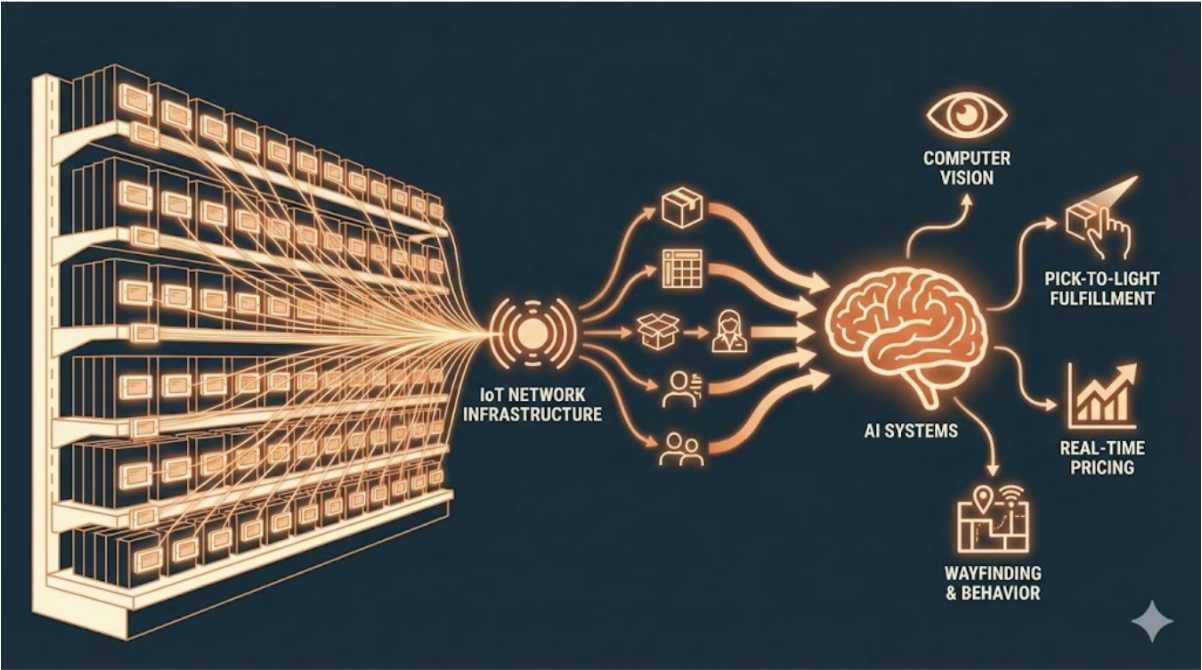
The ESL network creates infrastructure for computer vision, pick-to-light fulfillment (already doing millions of API calls weekly), and real-time planogram compliance. These use cases are impossible without pervasive connectivity.
AI without real-world signals is useless: retailers who skipped omnichannel infrastructure investments are now paying customers twice as much through third-party fulfillment. The same mistake is happening with AI readiness.
The killer app is a Trojan horse for infrastructure. Most retailers see ESLs as labor automation eliminating the paper label printing and manual price changes that previously took 14 days to execute across a store.
That's real: when tariffs changed 30 times in 45 days, retailers without dynamic pricing lost hundreds of millions in margin.
But Segura frames ESLs differently: "Once you have a network that's already deployed, how do you harness the signals?"
The ESL deployment creates something far more valuable than automated pricing. It creates pervasive connectivity. 100,000 radios per store means location data for every product position. Bluetooth connectivity means phones can talk to labels. Battery-powered computer vision cameras can plug into the same network without expensive data drops ($1,500-$4,000 per camera installation avoided).
This is the infrastructure AI actually needs. Retailers building chatbots and recommendation engines are working with incomplete data. Retailers with sensor networks generating real-time signals – inventory positions, planogram compliance, customer proximity, out-of-stocks – have the inputs to make AI useful.
The omnichannel mistake is repeating with AI. Segura draws a direct line from past failures: "15 years ago stores were just stores, then omnichannel came along and stores had to operate as fulfillment centers. Some retailers leaned into that and most did not make the investments required to understand what they owned in the building."
The result? Those lagging retailers now fulfill through third parties, and their customers pay twice as much for the same goods. The infrastructure investment they avoided became a permanent competitive disadvantage.
The same pattern is emerging with AI. "If I want to be agentic, if I want to use AI, I need inputs. The only way to get those inputs is to deploy sensors in the store to understand what you own, how many there are, where they're at, how customers are behaving, where your associates are."
Most retailers are building AI strategies without the signal infrastructure to make them work. It's omnichannel 2.0, and the winners and losers will be determined by infrastructure investments made today.
Verticalization beats best-of-breed for speed. Vusion controls hardware, software, AI, and applications. Segura argues this vertical integration is their primary competitive advantage: "The retailer just comes and talks to us. They just tell us what they want. They don't need to understand power budgets and Bluetooth channels."
The alternative – different vendors for hardware, software, and applications – creates coordination overhead that kills speed. "Agility is the most fundamental form of competitive advantage. If you're the fastest and you can execute well at speed, that's what makes you sticky and really dangerous."
This has direct implications for retail technology strategy. When evaluating vendors, time-to-value matters more than feature comparisons. A vertically integrated partner that can ship in months beats a best-of-breed stack that takes years to integrate.
What to do about this:
→ Audit your signal infrastructure before your AI strategy. Map what real-time data you actually have from stores: inventory positions, planogram compliance, customer traffic patterns, associate locations. If the answer is "we know 80% but 20% is our best guess" (like some major European retailers), your AI initiatives are built on sand.
→ Calculate your price change velocity. How many days does it take from a merchant decision to shelf execution? If it's more than 24 hours, you're leaking margin every time costs change—and in a tariff environment, that's constant.
→ Evaluate ESL vendors on ecosystem potential, not just label cost. The question isn't "how much per label?" It's "what else can this network enable?" Computer vision, pick-to-light, wayfinding, and retail media all become possible when connectivity infrastructure exists.
3. Lessons from IKEA’s “price first” product design
Editorial - Inside IKEA: The Brilliant Trick That Makes You Buy More (Jan 6, 2026)
Background: IKEA generates $45 billion in annual revenue with 900 million store visits and 4.6 billion website visits – all while deliberately lowering prices during high inflation. The secret isn't just cheap furniture. It's a complete system where ~60% of purchases are unplanned, customers do their own assembly (and value the products more because of it), and 700 million people eat in their cafeterias annually. Here's the framework that turns frugality into a competitive moat.
TLDR:
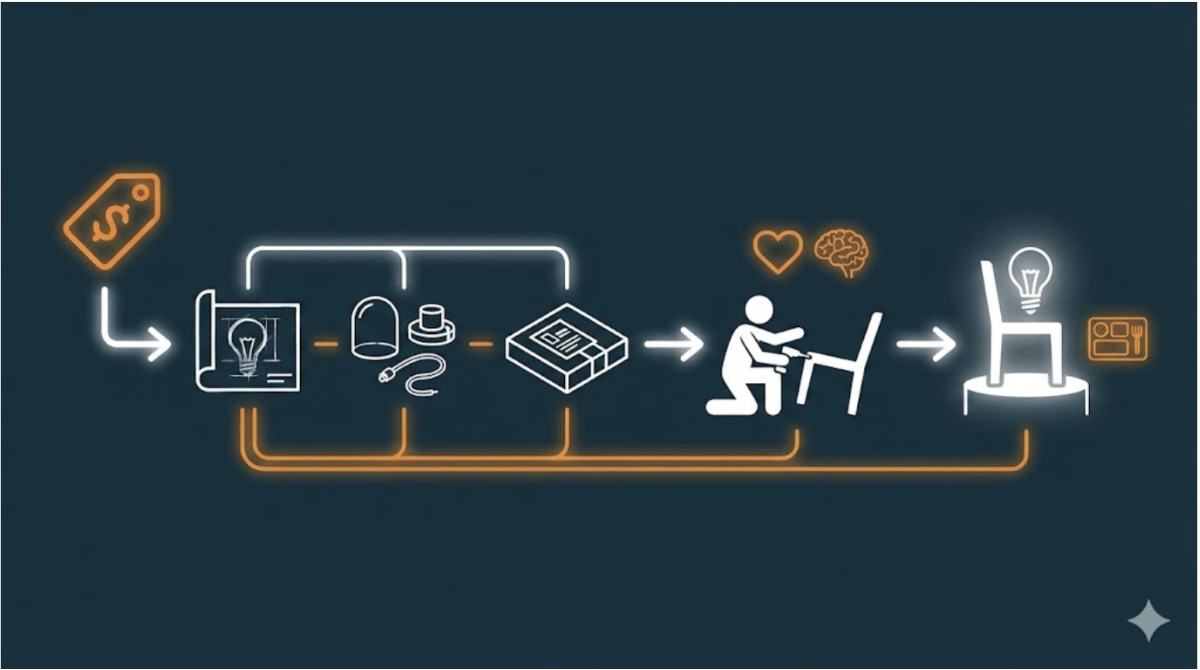
Design products backwards from a target price point rather than forward from concept: IKEA's $1 LED light bulb was reverse-engineered to hit the price, not priced after design, creating nearly impossible-to-match value positioning.
Customer labor isn't just cost savings: the "IKEA Effect" (proven in Harvard research) shows people value products more when they build them, turning assembly from a friction point into a loyalty driver.
Use food as a "momentum management tool": with 30% of shoppers visiting primarily for the cafeteria and 700M diners annually, ultra-cheap food resets decision fatigue and keeps customers in your ecosystem longer.
Start with price, then engineer backwards. Most retailers develop a product concept, then price it to hit margins. IKEA flips this completely. Designers start with a target price and engineer the product backwards to meet it.
When IKEA wanted to create a $1 LED light bulb, they didn't design a bulb and hope the cost worked out. They reverse-engineered every component to hit that exact price point.
The result was a price that competitors can’t match because they're not willing to redesign products from scratch around a price target.
Turn customer labor into emotional investment, not friction. The flat-pack model started in 1956 when designer Gillis Lundgren couldn't fit a chair in his car and removed the legs. What began as logistics efficiency became IKEA's biggest loyalty driver.
Harvard Business School researchers studying "The IKEA Effect" found that when people build something themselves, they value it more. Similar to how adding a fresh egg to instant cake mixes increased adoption (people felt more involved), IKEA industrialized this psychology at scale. Customers aren't just doing free labor – they're creating emotional attachment that drives repeat purchases.
Make food a strategic asset, not a loss leader afterthought. IKEA founder Ingvar Kamprad insisted on ultra-cheap food because "hungry customers buy less." But the 700 million annual cafeteria diners represent something more strategic: momentum management.
Food before shopping fuels customers for the maze. Food mid-trip resets decision fatigue. Food at exit leaves customers with – literally – a good taste in their mouth.
With 30% of visitors coming primarily for food then browsing furniture, the cafeteria is customer acquisition disguised as hospitality.
Curate ruthlessly to amplify scale economics. Despite massive stores, IKEA carries only 9,500 SKUs, compared to 120,000-140,000 at a Walmart Supercenter.
This deliberate simplification (a few well-designed options per need, not dozens) concentrates volume per product, enabling better supplier terms.
IKEA sells one Billy bookcase every 5 seconds worldwide. Those thin margins compound into massive profit when you're the world's largest wood consumer with 11-year average supplier relationships.
What to do about this:
→ Audit your product development process for "price-first" opportunities. Identify your most commoditized categories and challenge teams to start with a target price 30% below current, then engineer backwards. Even one successful reverse-engineered product creates powerful value perception.
→ Map where customers currently do labor and ask if it builds or erodes loyalty. Self-checkout saves costs but doesn't create emotional investment. Look for participation opportunities where effort creates ownership such as customization, configuration, personalization moments.
→ Evaluate your in-store food/refreshment as a strategic retention tool. Calculate average customer dwell time and decision fatigue points. Test whether mid-journey food options increase basket size or shopping duration.
Disclaimer
This newsletter is for informational purposes only and summarizes public sources and podcast discussions at a high level. It is not legal, financial, tax, security, or implementation advice, and it does not endorse any product, vendor, or approach. Retail environments, laws, and technologies change quickly; details may be incomplete or out of date. Always validate requirements, security, data protection, labor, and accessibility implications for your organization, and consult qualified advisors before making decisions or changes. All trademarks and brands are the property of their respective owners.
