
Revenue Teams Aren’t Evolving. They’re Being Re-Architected.
Welcome to DX Brief - Retail, every week, we distill industry podcasts and conferences into what you need to know
In today's issue:
Multi-year ERP migrations don’t make sense because today’s tech will soon be obsolete. Leave legacy systems alone and add agile front-end layers.
Deploy AI in-visibly to enhance human connection, not replace it. Every retailer can learn from luxury retail’s “invisible AI” blueprint.
David Rogers (the OG of DX) sees the same mistake playing out with AI that plagued early digital initiatives: companies obsess over technology instead of business redesign.
1. Multi-year ERP migrations don’t make sense because today’s tech will soon be obsolete. Leave legacy systems alone and add agile front-end layers.
The Growth Advantage podcast, Mishipay CEO Mustafa Khanwala: Scaling Retail Tech, AI Automation & Future of Checkout! (Feb 10, 2026)
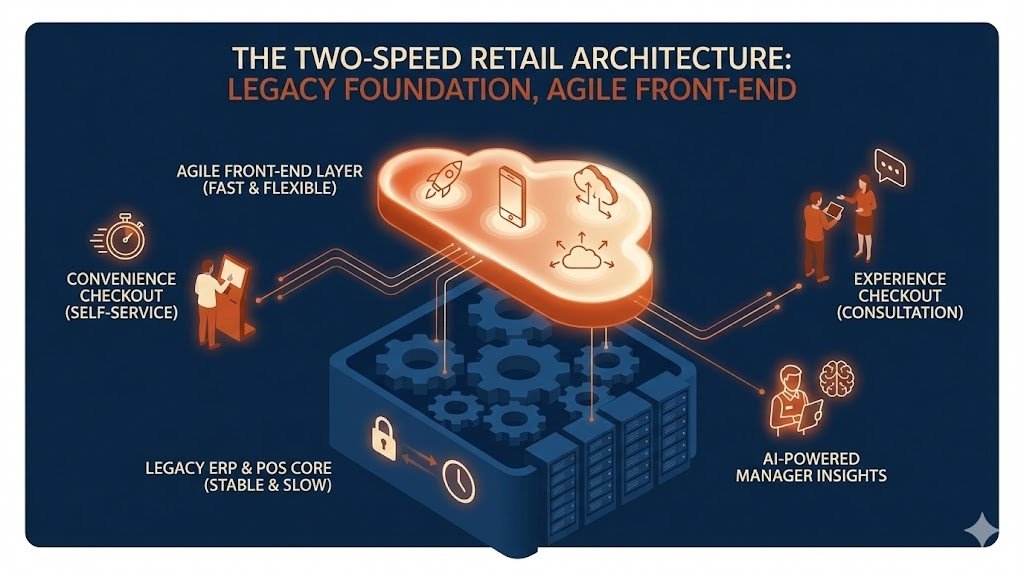
Background: MishiPay started 10 years ago when founder Mustafa Khanwala waited 20 minutes to buy a single can of Coke at a London grocery store. Today they're in 2,000+ stores from the US West Coast to Australia, processing hundreds of millions in transactions. The secret isn't their checkout hardware – it's a cloud-native architecture that lets retailers launch a new loyalty program in 10 days or switch payment providers in two weeks, without touching their legacy ERP.
TLDR:
The traditional POS upgrade playbook – multi-year ERP migrations costing millions – is broken because the technology of today won’t satisfy the customer experience of tomorrow. The solution is to leave legacy systems along and add an agile front-end layer.
Store checkout is bifurcating into two distinct experiences: convenience (self-checkout for customers who know what they want) and experience (mobile POS for customers who want consultation). Design for both.
AI-powered analytics chat is coming to store managers: natural language queries to understand best-selling items, worst-selling items, and recommended promotions, with one-click action to implement price changes.
Your ERP is fine – what you need is an agile front-end. The standard retail technology playbook says: upgrade your ERP/POS system. But Khanwala calls this out: "You're talking about a project that takes years, costs millions, and still probably doesn't achieve the result."
Why? Because the only guarantee is that today's technology won't satisfy tomorrow's customer experience requirements. MishiPay's alternative: keep the legacy system for product files, promotions, and POS logs. Layer a flexible, cloud-native front-end on top.
The mobile-first architecture allows them to "plug into their systems" without forcing retailers to invest in infrastructure changes.
Agility is measured in days, not quarters. What does "flexible" actually mean? Being able to launch a new promotion scheme in two days, launch a new loyalty program with a retailer in 10 days, or change payment providers in two weeks. "That kind of agility just doesn't exist with the traditional POS landscape."
This isn't about moving fast for its own sake. It's about matching the speed of changing consumer expectations. There's a new wallet customers want to use? Integrate it. New loyalty scheme? Ship it. Your legacy vendor simply cannot respond at this pace.
Checkout is splitting into two experiences – design for both. Khanwala sees store checkout dividing into distinct tracks.
First: convenience. Customers who know what they want should check out as quickly as possible. "Today the store experience is amazing in terms of browsing and discovery. The users find what they want. They love it. That's the peak of their journey. From there, when you add barriers to checkout, you're giving them a bad climax." Self-checkout solves this.
Second: experience. Customers who want recommendations, consultation, and time with staff. Mobile POS enables this. Checkout happens anywhere in the store, not at designated registers.
Both are valid; neither replaces the other.
AI analytics for store managers changes the decision-making layer. Most AI retail discussions focus on customers. Khanwala focuses on store managers: "People who are actually on the ground don't have information and insight for decision making."
Currently, data has to flow to headquarters, get analyzed by a business analyst team using PowerBI, and decisions come back down through multiple layers.
MishiPay is launching a chat capability that lets store managers "talk to the data with natural language" – best-selling items, worst-selling items, recommended promotions.
Level one is insight. Level two is action: if AI recommends a price markdown on 10 items, they can execute it with one click. This is where electronic shelf labels finally make sense. AI-powered pricing needs instant label updates to deliver ROI.
What to do about this:
→ Map your "technology pivot time" for key capabilities. How long would it take you to switch payment providers? Launch a new loyalty integration? Add a new wallet option? If the answer is measured in months or quarters, you have an agility problem that's costing you competitive advantage.
→ Audit your checkout experience through the convenience vs. experience lens. Identify which customer segments want speed and which want consultation. Are you forcing consultation customers through self-checkout? Are you making speed-focused customers wait for staff? Design distinct paths.
2. Deploy AI in-visibly to enhance human connection, not replace it. Every retailer can learn from luxury retail’s “invisible AI” blueprint.
Coresight Research’s Retaili$tic podcast w/ Ben Miller (Director, Shoptalk): Insights from Shoptalk Lux (Feb 10, 2026)
Background: Shoptalk just launched a luxury-focused conference in Abu Dhabi. The insight that applies beyond luxury: the sector that under-indexes most on e-commerce has developed the clearest framework for AI deployment. They call it "invisible AI": use AI everywhere operationally, but never let customers see it.
TLDR:
"Invisible AI" means deploying AI to make operations run better and empower staff, but keeping it invisible to customers who value personal connection. This framework applies to any retailer with high-touch segments.
Luxury lost 50-70 million active customers between 2022 and 2025, concentrating sales among top buyers (now ~50% of sales vs 30% in 2019). The response of raising prices further eroded trust and must be reversed through volume growth.
Resale is growing 2-3x faster than new fashion and 90%+ goes through marketplaces. Brands treating resale as a customer acquisition channel rather than cannibalization threat are winning.
Deploy AI invisibly to enhance human connection, not replace it. Luxury retail significantly under-indexes on e-commerce penetration. The reason: maintaining personal connections through in-store relationships and personal sellers who manage high-net-worth clients.
When these retailers think about AI, they ask a fundamentally different question than mass retail: "How do we drive efficiency and empower our teams to do a better job without customers seeing the technology?"
Ben Miller, who comes from a grocery background, found this reframing powerful. "As a sector, the idea of 'use AI to make my business run better but I don't want my customers to see it' is most extreme in luxury. But then think about how that plays through into other parts of retail."
The question every retailer should ask: which customer segments expect personal connection, and how do we use AI to enhance (not replace) the human delivering that connection?
The aspirational customer exodus demands a volume response, not more price increases. Between 2022 and 2025, luxury lost an estimated 50-70 million active customers globally. The bifurcation of wealth created winners and losers: top customers now account for nearly half of all luxury sales, up from about 30% in 2019. Middle-income consumers who stretched to buy luxury during the pandemic have been squeezed out.
Many luxury brands responded with significant price increases, doubling down on the ultra-wealthy. The problem: this eroded trust. "Trust has been eroded because of the level of price increases. We can't as an industry just rely on price. We've got to generate some more volume."
The playbook of protecting margin through price has run its course. Brands now need digital demand creation targeting younger consumers, the right merchandise at the right price points, and entry points like resale to rebuild the customer base.
Resale is a scale game – treat it as customer acquisition, not cannibalization. Resale in fashion is growing 2-3x faster than buying new. But here's the problem: over 90% of resale in the US goes through marketplaces. Brands lose the customer relationship, the data, and the ability to build loyalty.
The brands winning at resale treat it as an entry point. "Recognize resale as an entry point rather than something that other people will do. If you have consumers who are craving individuality and are excited by your brand, you want to bring them in and bring them on that journey rather than send them off to a marketplace."
The economics are challenging. Resale requires scale to be profitable due to sourcing, authentication, refurbishment, and logistics costs. Two of the Shoptalk Lux startup pitch finalists focused on helping brands take cost out of resale operations. The bet: brands that own their resale channel capture customers who trade up to full-price over time.
What to do about this:
→ Audit your AI deployment through the "invisible AI" lens. For each AI initiative, ask: does this replace human interaction where customers expect it, or does it enhance human capability? Reallocate AI investment toward tools that make frontline staff more effective rather than customer-facing automation in high-touch segments.
→ Evaluate owned resale as a customer acquisition channel. Run the unit economics: customer acquisition cost through resale vs. traditional channels, and lifetime value of customers who enter through resale vs. full-price. If the numbers work, the strategic question is build vs. partner – two Shop Talk Lux finalists specifically enable brands to operate resale profitably without building internal infrastructure.
3. David Rogers (the OG of DX) sees the same mistake playing out with AI that plagued early digital initiatives: companies obsess over technology instead of business redesign
The Innovation Show (Kyndryl podcast): Digital Transformation Playbook (10 Years On) AI, Disruption & Platform Strategy with David Rogers (Feb 11, 2026)
Background: David Rogers wrote the first book on digital transformation. Ten years later, he's been advising everyone from Tata Motors to global retailers. The distinction between retailers getting real enterprise value from AI and those stuck in pilot purgatory? Whether they start with the technology or start with the business question.
TLDR:
Digital transformation is now a core leadership competency. It's no longer the "sexy new thing" owned by a CDO. It's table stakes for COOs, general managers, and CEOs running modern retail operations.
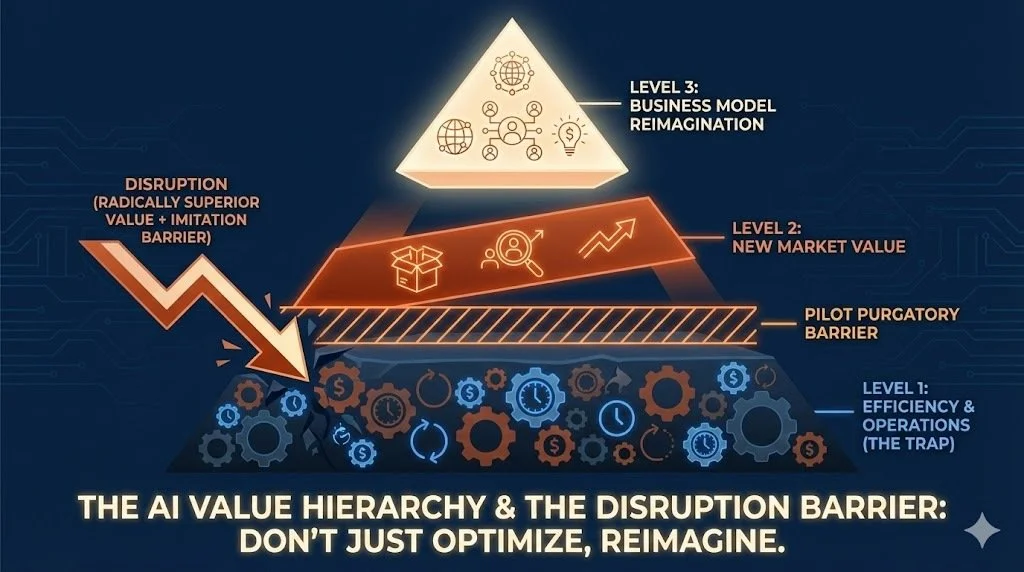
Most retailers are stuck at Level 1 of AI value (efficiency and operations). The real opportunity lies in Levels 2 and 3: creating new value for the market and reimagining business models entirely.
Business disruption happens when a challenger offers "far greater value in a way existing firms cannot compete with directly," and the barrier to imitation in your value network determines whether you survive.
AI value operates on three levels, and most retailers never get past level one. Rogers sees a predictable pattern across industries: companies deploy AI for efficiency and operations ("How do I run my current business cheaper and faster?") and stop there.
The better companies ask a different question: "What new value could I create for the market?" This means improving upon your business model as it exists.
But the highest level of transformation asks: "How might AI allow us to reimagine and explore new business models entirely?"
The distinction matters because efficiency gains are table stakes. Every competitor will eventually automate the same processes. The sustainable advantage comes from using AI to do something you haven't done before… to reorganize what you do versus what others do, to redefine where you add value and where you partner.
Digital transformation is no longer a project – it's a permanent leadership function. When Rogers first published the playbook, he was mostly talking to Chief Digital Officers and heads of digital transformation. That era is ending.
Now his engagements are with COOs, general managers, and CEOs. "If you're in that kind of role," he explains, "strategy, operations, developing your talent – one of the core things you do now is also digital transformation. It's not the sexy new thing. It's central to the life of the company."
This shift has profound implications for how retail organizations structure themselves. The companies that treated digital as a three-year project are struggling. The ones who embedded it as an ongoing capability – wave after wave of change – are the ones thriving.
Disruption requires two conditions: radically superior value AND a barrier to imitation. Rogers expanded Clayton Christensen's famous disruption theory to explain cases like the iPhone disrupting Nokia – something Christensen's original model couldn't predict.
The new framework: disruption happens when a challenger offers "far greater value to the customer in a way that existing firms cannot compete with directly."
You need both conditions. A competitor can offer dramatically better value, but if you can simply copy their approach, that's competition, not disruption.
The barrier lies in what Rogers calls the "value network" – the combination of data, partnerships, distribution, assets, talent, and IP required to deliver the offering. When incumbents lack a critical ingredient in the challenger's value network, they face true disruption.
What to do about this:
→ Audit your AI initiatives against the three-level value framework. List every AI project in flight. Categorize each as Level 1 (efficiency/operations), Level 2 (new value for market), or Level 3 (business model reimagination). If everything clusters at Level 1, you're optimizing for table stakes.
→ Assign someone to think about non-customers. Christensen's enduring insight: your current customers will tell you not to worry about disruptive threats. Designate a small team whose explicit job is to focus on people who are NOT your customers and what they need.
→ Map your value network against emerging competitors. When a new entrant appears, use Rogers' two-part test: Does their value proposition radically surpass yours for some customer segment? And is there something in their value network that you cannot replicate? If both answers are yes, you're facing disruption, not competition.
Disclaimer
This newsletter is for informational purposes only and summarizes public sources and podcast discussions at a high level. It is not legal, financial, tax, security, or implementation advice, and it does not endorse any product, vendor, or approach. Retail environments, laws, and technologies change quickly; details may be incomplete or out of date. Always validate requirements, security, data protection, labor, and accessibility implications for your organization, and consult qualified advisors before making decisions or changes. All trademarks and brands are the property of their respective owners.
