
Digital Stores, AI Frontlines, and the Rise of Agent Commerce
Welcome to DX Brief - Retail, where every week, we distill industry podcasts and conferences into what you need to know.
In today's issue:
The future of retail is a digital layer over everything – and what that means for your stores
Best Buy and Circle K prove that AI wins when it empowers frontline staff, not replaces them
Your website needs to become a fulfillment center for AI agents (not just customers)
1. The future of retail is a digital layer over everything – and what that means for your stores
Firebelly Marketing podcast, The Future Of Retail Is Digital with Eric Martindale (Jan 30, 2026)
Background: Eric Martindale's agency has driven over half a billion dollars in retail sales for CPG clients. His observation: every major retailer is now promoting e-commerce leaders into enterprise leadership roles. Walmart's new CEO John Furner ran e-commerce programs. Their new Chief Growth Officer ran Walmart Connect and Walmart Data. Target has 68% of customers using the app while they shop in stores. BJ's just announced interactive endcap screens and mobile checkout. The message is unmistakable: physical retail is becoming a digital experience, and the retailers who understand this are reorganizing their entire leadership structure around it.
TLDR:
BJ's is the underrated opportunity for CPG brands: higher SKU count than Costco, less competition, and now rapidly digitizing with interactive screens and mobile checkout. Recommended media mix: 45% BJ's media, 45% Instacart, 10% DoorDash.
Target's 68% in-store app usage is unmatched – no other retailer comes close. They're driving 30-40% of some brand's sales through Roundel despite declining foot traffic. The app is the store now.
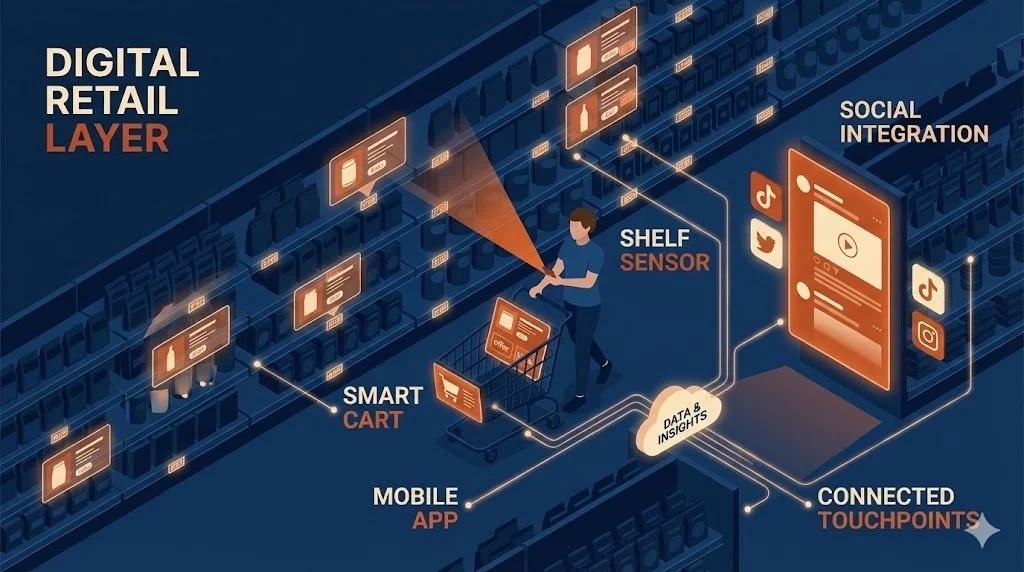
Every physical touchpoint is becoming digital: smart carts, shelf sensors, QR codes, RFID on produce, door sensors. Social media will integrate directly with physical stores within the next 12-18 months.
Watch where retailers promote from – it tells you where they're going. The three senior positions filled at Walmart this month all went to people who ran e-commerce and digital programs internally. The incoming CEO led e-commerce initiatives. The new Chief Growth Officer ran Walmart Connect and Walmart Data. Walmart isn't hiring digital transformation consultants – they're promoting the people who already proved they could build digital businesses at scale.
Why does this matter? Because Walmart e-commerce is growing faster than Amazon and delivering profitably, which makes them "one of maybe two" retailers who can say that. When a company starts stacking its C-suite with people from one discipline, that discipline becomes the company's center of gravity. Walmart has decided the future is digital.
Target's app penetration is its hidden weapon. Capital One's credit card data shows that 68% of Target customers use the Target app while shopping in stores. No other retailer comes close. This isn't just about mobile payments. It's about Target having a direct digital relationship with customers while they're physically present. The challenge is getting people to order from outside the store through the app, not just use it while browsing.
Here's the tension: Target's foot traffic is declining month over month, but buyer sales goals aren't coming down. That means brands must lean harder into Roundel, Target's retail media platform. One brand Martindale works with drives 40%+ of their Target sales through Roundel. When physical traffic drops but digital engagement stays high, the brands that win are the ones who meet customers where they actually are – on the app.
Every analog surface is a potential digital touchpoint. Shelf tags can be electronic. Shelf sensors detect out-of-stocks. Smart carts track what goes in them. QR codes link to content and offers. RFID tags work even on produce now. Door sensors track who enters and exits. The technology exists to make every physical interaction in a store a digital data point. Sam's Club already has mobile self-checkout. BJ's just announced it. Aldi is piloting Instacart terminals at store entrances.
Martindale predicts social media will connect directly to physical stores within 12-18 months: TikTok content pushed from stores, in-store screens connected to social feeds. "Everything that has a screen on it is going to be connected to your store, and your store is going to be connected to it."
What to do about this:
→ Map every physical touchpoint in your stores that could become digital. Walk your stores and identify: shelf tags, endcaps, checkout lanes, fitting rooms, entrances, product displays. For each, ask: could this collect data? Could this display personalized content? Could this connect to our app or loyalty program? Then prioritize by impact and feasibility.
→ Start planning for social-to-store integration. If Martindale is right, TikTok and Instagram content will soon push directly from stores, and in-store screens will display social content. Start building the content assets and infrastructure now.
2. Best Buy and Circle K prove that AI wins when it empowers frontline staff, not replaces them
Power Talks: Using Data and AI to Redefine Global Customer Experience | Ft. Best Buy & Circle K (Jan 27, 2026)
Background: Circle K operates 19,000 stores across multiple geographies serving 9.5 million loyalty customers making split-second purchase decisions. Best Buy serves customers who research for weeks before buying a TV. Yet both companies have landed on the same AI deployment principle: technology should make frontline employees smarter, not obsolete. Their AI centers of excellence in India are now driving everything from real-time offer personalization to LLM-powered product search, and they're measuring success by the one metric that matters: whether customers come back tomorrow.
TLDR:
Build AI centers of excellence that focus on reducing friction for both customers and frontline staff. Best Buy and Circle K both prioritize tools that help associates serve customers better, not tools that replace human judgment.
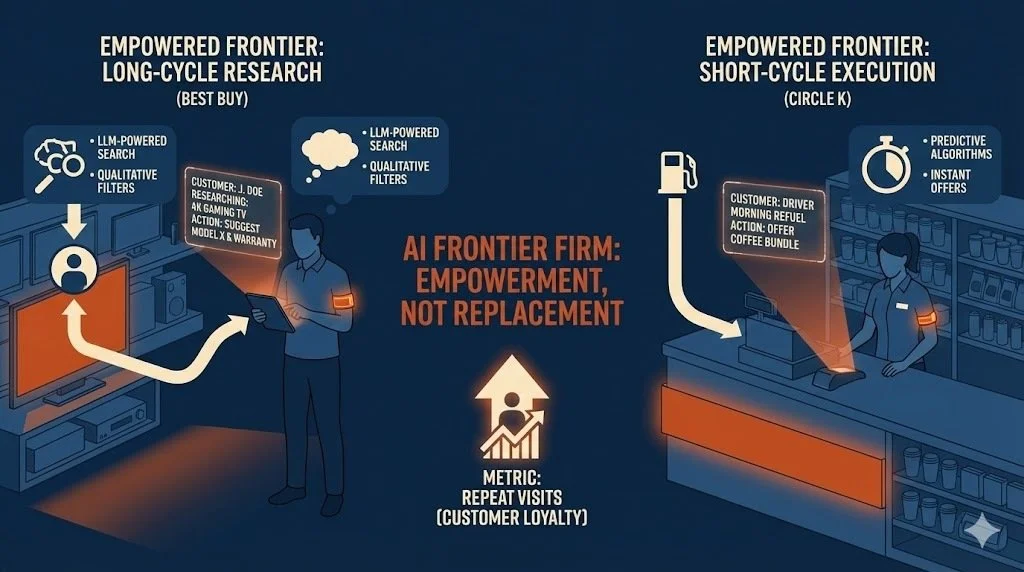
Measure AI success by repeat visit rates, not just conversion. Circle K's philosophy is that if a customer visits 3 days a week, the goal is getting them to 4 or 5 days, because basket sizes are small but frequency compounds.
Personalization without intrusion means knowing when NOT to offer. Circle K explicitly avoids bombarding coffee regulars with irrelevant promotions, instead matching offers to customer segments (drivers get fuel deals, students get snack offers).
AI should arm your frontline, not replace it. Best Buy built an AI-powered customer service system that doesn't answer customer questions directly. It feeds information to the human agent so they can answer faster and better.
When a customer calls, AI instantly surfaces their purchase history, warranty status, and likely issue. The agent doesn't have to search for anything. They copy-paste AI-generated responses tailored to that customer's situation. This is fundamentally different from the chatbot-first approach most retailers take. Best Buy's bet: humans with AI tools beat AI alone.
Circle K takes this further with their store employees. As Sushant Bushan puts it, the real barrier to AI adoption isn't technology; it's whether frontline workers understand what to do with it.
Circle K doesn't give store staff complex dashboards. They give specific actions like:
When a loyalty customer enters, do this.
When a driver finishes fueling, offer this.
The AI does the segmentation work invisibly. The employee just needs to execute.
Speed of decision must match speed of purchase. Best Buy customers research for weeks. They're "upper funnel" browsers who don't know what they want, or "spear fishers" who know exactly what they need.
Best Buy built an LLM-powered search that provides qualitative filters (not just "price low to high" but "good for a first-time gamer") and an AI gift finder chatbot that helps the undecided. These tools work because Best Buy's purchase cycle allows for exploration.
Circle K operates in minutes, not weeks. A customer fueling up at 6 AM doesn't want 10 offers. They want the right offer at the right moment. Maybe a breakfast sandwich bundle as they're finishing their fill-up. Circle K uses predictive algorithms to determine not just what to offer, but when to offer it and to whom.
Legacy systems are the real blocker; not AI capability. Both executives identified the same constraint: data sitting in silos built over decades. Best Buy has "really great data when customers are online but when customers are in stores, unless they're purchasing something, sometimes you lose sight of them."
Yet someone who drives to a store, finds parking, and walks to the TV section has much higher intent than someone browsing from their couch. Capturing that in-store intent data without being "creepy" is the unsolved problem both companies are working on.
What to do about this:
→ Audit your AI investments through the "frontline empowerment" lens. For each AI project, ask: Does this make our store or call center employees faster and better? Or does it just replace them with something customers tolerate? The former compounds; the latter creates resentment and churn.
→ Match your personalization speed to your purchase cycle. If you're in convenience retail, real-time segmentation and instant offers matter. If you're in considered purchases, AI-assisted research and discovery tools matter more. Don't build the wrong AI for your category.
→ Define your one metric for AI success. Circle K chose repeat visits. Best Buy chose customer experience scores. Pick one metric that captures whether AI is actually helping customers, then measure every AI initiative against it.
→ Simplify AI outputs for frontline staff. Don't give employees dashboards; give them 3 specific actions. When X happens, do Y. The AI should do the complex work invisibly.
3. Your website needs to become a fulfillment center for AI agents (not just customers)
WBS podcast: Business Growth with ERP and Digital Transformation - Scale Growth by Learning the Top Retail Digital Transformation Trends In 2026 w/ Sam Gupta (Feb 2, 2026)
Background: Sam Gupta, principal at ElevatIQ, just released his annual retail digital transformation trends report. ChatGPT, Gemini, and Perplexity aren't just answering questions anymore. They're browsing e-commerce websites and enabling consumers to purchase directly from the chat interface. Your website isn't just competing for human eyeballs. It's now competing to be discovered, indexed, and recommended by AI agents.
TLDR:
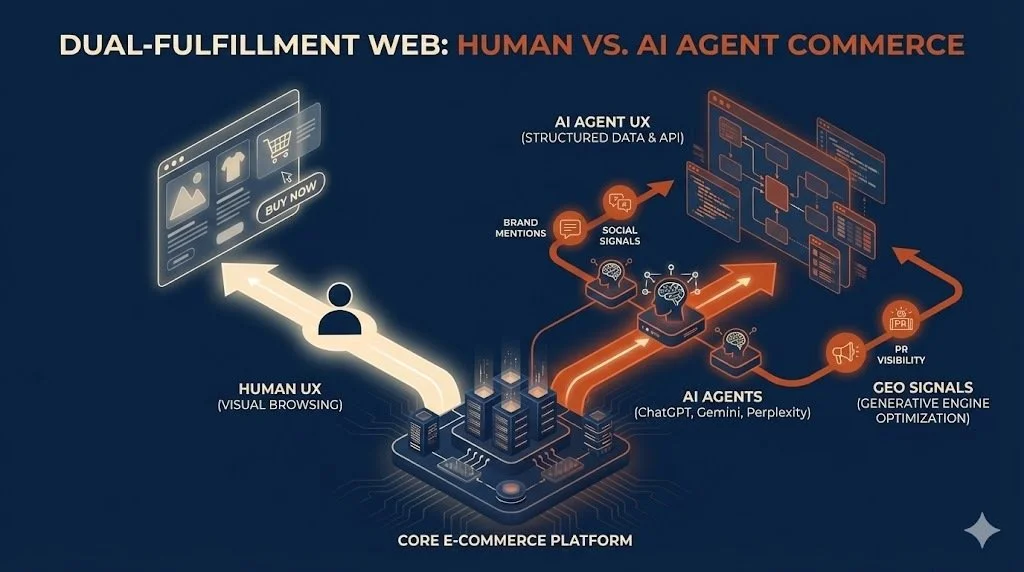
AI agents will soon browse and buy from your e-commerce site on behalf of consumers. Your website needs to be optimized for machine interaction, not just human UX.
Agentic customer service will outperform offshore call centers because AI can be trained on thousands of scenarios and deliver consistent, qualified answers that weren't economically viable with human agents.
The displacement of search traffic to generative AI platforms means your SEO strategy must expand to "GEO" (Generative Engine Optimization), including brand mentions, social signals, and PR visibility.
Your website is becoming a fulfillment center for AI agents. Three years ago, ChatGPT could only have conversations and browse the web. Now these generative AI technologies can browse e-commerce sites and enable shoppers to buy directly from the chat interface.
This is a fundamental shift in the technology landscape. Most e-commerce channels relied on their websites to drive traffic alongside marketplaces like Amazon and eBay. But now there's a completely different interface that brands need to optimize for.
The implication: E-commerce platforms will need to invest substantially in platform innovation to make their systems compatible with generative AI technologies. Brands need to assess whether their current web storefronts will work with these new interaction patterns, or risk becoming invisible to a growing segment of AI-mediated commerce.
Agentic customer service will replace offshore, and often outperform it. Traditional e-commerce relied on offshore customer service because local support was too expensive to justify on thin product margins. The experience was hit or miss. But agentic workflows are likely to be superior for most scenarios. Why? AI can be trained on thousands of scenarios and deliver qualified answers that simply weren't possible from human-centric customer service at scale.
If you're re-platforming your systems, you need to make sure your platforms are investing substantially in agent capabilities.
GEO is the new SEO, and it's more comprehensive. The majority of traffic share is shifting from search engines to generative AI technologies. ChatGPT has the biggest market share, followed by Google's Gemini and Perplexity.
But here's what most retailers don't understand: SEO is still relevant because AI workflows browse the web and index pages using SEO signals.
The difference between GEO and SEO? Generative engines look at more signals: your brand mentions, how actively you're mentioned on social media, directories, and PR channels. It's a far more comprehensive view than traditional search engine optimization.
AI-native software is disrupting every category, except maybe e-commerce. Investors are pouring money into AI-native platforms across ERP, FP&A, S&OP, and CRM. These aren't legacy systems with AI bolted on top; they're built from the ground up with AI at the core.
But here's the interesting exception: if consumers start shopping directly on generative AI interfaces, AI-native e-commerce platforms may be less relevant because the website itself becomes a fulfillment channel rather than the primary customer interface.
What to do about this:
→ Audit your e-commerce platform's AI compatibility. Schedule a technical review in the next 30 days to assess whether your current storefront can be effectively indexed and interacted with by AI agents. Ask your platform vendor about their generative AI roadmap.
→ Expand your SEO strategy to GEO. Beyond traditional search optimization, map your brand mention strategy across social media, directories, and PR channels. These signals now directly impact whether AI agents recommend your products.
→ Evaluate agentic customer service pilots. Before your next platform contract renewal, test AI-powered customer service on a contained product line. Measure resolution rates and customer satisfaction against your current offshore benchmarks.
→ Reassess your enterprise software roadmap for AI-native alternatives. For each major system category – ERP, CRM, supply chain – identify whether AI-native startups are disrupting incumbents. Don't assume your current vendor's AI bolt-on will compete with purpose-built solutions.
Disclaimer
This newsletter is for informational purposes only and summarizes public sources and podcast discussions at a high level. It is not legal, financial, tax, security, or implementation advice, and it does not endorse any product, vendor, or approach. Retail environments, laws, and technologies change quickly; details may be incomplete or out of date. Always validate requirements, security, data protection, labor, and accessibility implications for your organization, and consult qualified advisors before making decisions or changes. All trademarks and brands are the property of their respective owners.
