
Invisible AI, Real ROI: What Actually Scales in Retail
Welcome to DX Brief - Retail, where every week, we distill industry podcasts and conferences into what you need to know.
In today's issue:
How Tractor Supply equipped 52,000 employees with AI by making it invisible
PepsiCo achieved 20% labor improvement by simulating before spending – hunt for ROI at automation boundaries
The case for domain-specific AI and AI-native vs AI-applied
1. How Tractor Supply equipped 52,000 employees with AI by making it invisible
The C-Suite podcast, Inside NRF (Part 2 of 3): Scaling AI and Resilience in Modern Retail (Jan 21, 2026)
Background: While 90% of AI initiatives fail, Tractor Supply has deployed AI tools to all 52,000 team members across 2,400 stores, and customers are actively using their AI shopping assistant, Scout AI, built with OpenAI. More remarkably, they've already made their site agentic-browser compatible, meaning AI agents can shop on behalf of customers. Glenn Allison, VP of Enterprise AI Platforms, shared how they moved from pilots to production at scale.
TLDR:
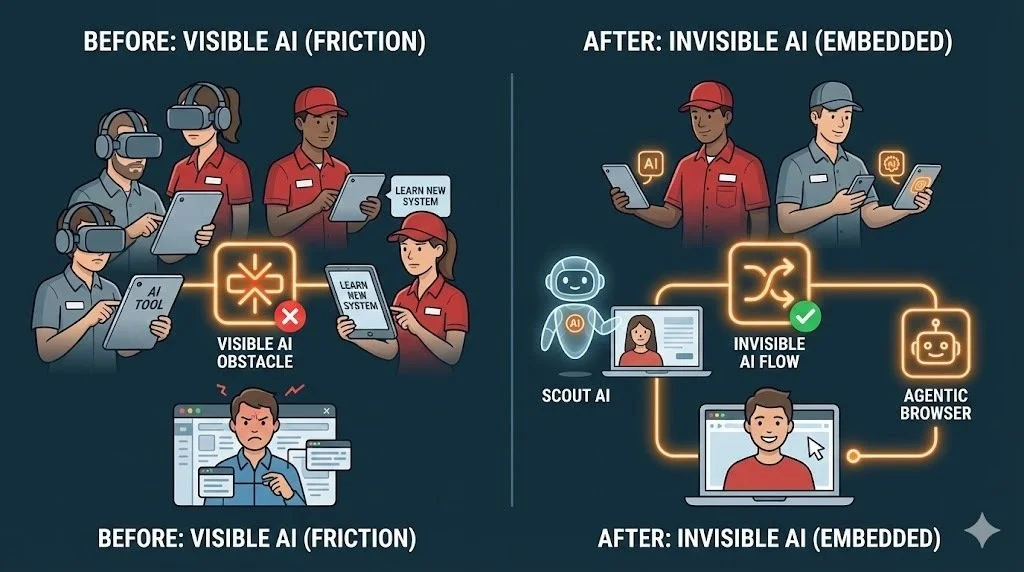
Embed AI into existing tools employees already use (mobile devices, workflows) rather than forcing new behaviors. Tractor Supply put voice and chat AI directly into team member mobility devices for instant access to product info and recommendations.
Build customer-facing AI that assists purchase decisions, not just answers questions. Scout AI asks clarifying questions about lot size and terrain before recommending zero-turn mowers, driving adoption because it actually helps.
Prepare now for agent-to-agent commerce by making your site compatible with agentic browsers like OpenAI's Atlas. Tractor Supply has already observed AI browsers using their Scout AI to get better recommendations.
Make AI invisible by embedding it where employees already work. Tractor Supply didn't ask employees to learn new systems. They embedded AI capabilities – voice and chat access to product data, inventory, and recommendations – directly into the mobile devices team members already carry. The result: employees can access AI-powered assistance anywhere in the store, whether in the garden center, side lot, or at the register.
The key insight here is friction elimination. Most retailers add AI as another tool employees must remember to use. Tractor Supply made it part of the device they're already holding. Glenn Allison emphasized they focused on making it "really easy for them to be able to access and use."
Build AI champions across every department, not just IT. Tractor Supply's rapid adoption wasn't driven by the technology team alone. They created AI champions in every department who advocate for AI capabilities and help accelerate adoption. This distributed ownership model means AI use cases emerge from the people who understand the work, not just from technologists imagining how work gets done.
This matters because AI adoption is fundamentally a change management challenge, not a technology challenge. When you have advocates embedded in finance, store operations, supply chain, and marketing, you get practical use cases that actually solve real problems.
Prepare for agent-to-agent commerce now! Tractor Supply has already observed OpenAI's Atlas browser (an agentic browser) using their Scout AI assistant to get more personalized recommendations. That's an AI agent using another AI agent to shop.
Allison's team made tractorsupply.com agentic-enabled, meaning customers can prompt Atlas to find a zero-turn mower for a 5-acre lot, add it to cart, and surface it for checkout confirmation. While Allison notes customers will still want stores and apps, he's thinking ahead: "As consumers change potentially how they want to shop, we're going to make that easy for them."
The implication is significant. If your site isn't optimized for AI agents to navigate, you're already falling behind. And as Allison pointed out, standards for agent-to-agent communication are actively being developed through industry councils.
What to do about this:
→ Audit where your employees access information today. Identify the devices and systems they already use constantly, then explore embedding AI capabilities there rather than launching standalone AI tools.
→ Establish AI champions in non-IT departments. Identify one advocate in operations, marketing, merchandising, and supply chain. Give them early access to AI tools and make them responsible for surfacing practical use cases from their teams.
→ Test your site with agentic browsers this quarter. Download OpenAI's Atlas or Google's agentic browser tools and attempt to complete a purchase on your site using only prompts. Document where the experience breaks.
2. PepsiCo achieved 20% labor improvement by simulating before spending – hunt for ROI at automation boundaries
AI in Retail: Developing the Intelligent Supply Chain - Big Idea Session at NRF '26 (Jan 23, 2026)
Background: PepsiCo just announced a 20% labor and throughput improvement at their Grand Prairie facility using digital twin simulation, and they're now scaling to 100+ buildings with Siemens. But the real insight isn't the technology. It's how they identified what to simulate. Jeremy Jarrett from Kinetic Vision revealed the secret: hunt at the boundaries of your automation systems, where the biggest inefficiencies hide in plain sight.
TLDR:
Simulate everything before spending a dollar on new buildings or upgrades. PepsiCo couldn't figure out why pickers were only productive 40-50% of the time until they uploaded everything into a digital twin and tested scenarios they couldn't try in an operating building.
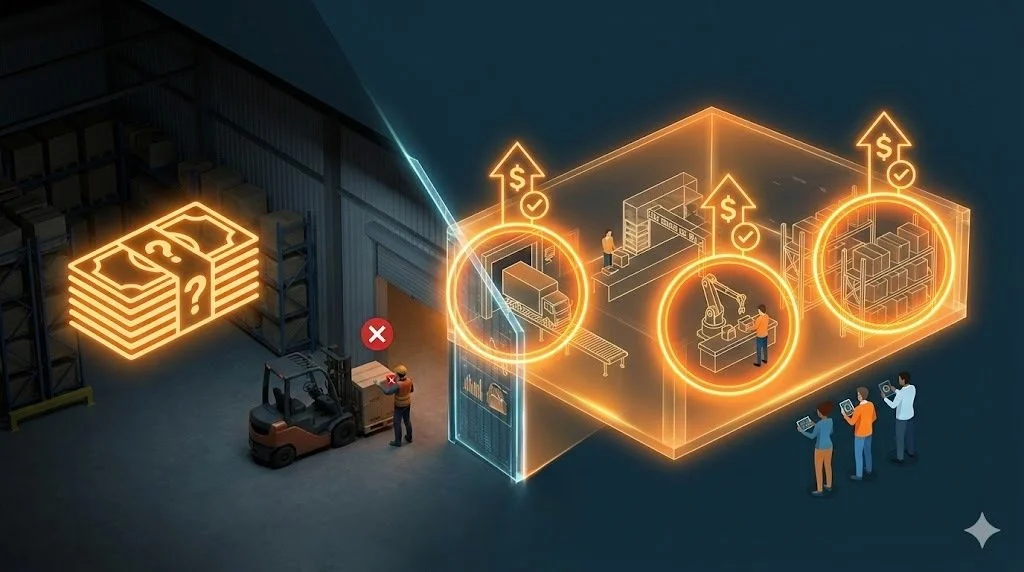
Hunt for ROI at automation boundaries (dock doors, picking stations, storage interfaces). One facility achieved 70% throughput improvement just by giving operators a login to handle inbound and outbound simultaneously.
Start with a small, passionate team with agency. Another reorg won't solve this. You need people with domain expertise, leadership mentality, and permission to fail fast.
Simulation isn't a tech stack. It's a different decision mindset. Anna Farberov from PepsiCo explained that the business case for digital twins isn't about flashy technology. It's about changing how quickly you can make decisions. Today, most retailers find out about problems reactively: the store is already out of stock, the supply chain already needs to roll back. With simulation, you can see the problem before it happens and change your trajectory in advance.
PepsiCo spent years proving the business case in progressively larger environments. From a small picking station to a full building to larger buildings. Now they know it works and are scaling across warehouses, logistics, and manufacturing. The key unlock? "Simulation for the sake of simulation" isn't the point. The point is giving frontline operators enough insight to make faster, better decisions.
Hunt at the boundaries where automation meets operations. Jeremy Jarrett shared the secret to finding quick ROI: look at the edges of your systems. Dock doors are a mess. Picking stations are where storage meets human labor. The interface between your facility shell and your operations is where inefficiencies compound.
One concrete example: operators at a PepsiCo facility were watching their iPhones for 15-20 minutes at a time while waiting on blocked inbound conveyors. Meanwhile, a truck right next door had pre-staged outbound ready to load.
The problem? They didn't have a login to Blue Yonder to do both tasks. Simulation uncovered this. The fix was trivial. The result was 70% improvement in throughput – from three shifts to two shifts.
Another boundary: storage and rack. Using a digital twin, they determined they could add more rack in a sold-out distribution center. During peak months when inventory constraints limit revenue, a 10-25% storage increase on a $5-10 billion top line translates to $100-250 million in additional revenue, just from installing new rack.
Small teams with passion beat reorganizations. Jeremy was direct: "Another reorg is not going to solve these problems. This is a people issue, not a technology issue anymore."
The retailers succeeding with AI have small teams with three characteristics: deep expertise in the business or technology, a leadership mentality, and permission to fail.
Anna added that these teams need to operate like startups within the company: clear mandate and ability to take decisions, but guardrails to keep them focused on problems that matter to the business.
The technology stack is ready. Nvidia's workflows can take developers from requirements to deployed robots. Siemens is partnering with PepsiCo to scale digital twins across the enterprise. But none of it matters without the organizational willingness to start.
What to do about this:
→ Identify your automation boundaries this quarter. Map the interfaces between your WMS, AGVs, picking stations, dock doors, and storage systems. These boundaries are where the biggest inefficiencies hide and where simulation delivers the fastest ROI.
→ Build a small team with agency, not a new org chart. Find 3-5 people with domain expertise and a passion for this work. Give them a clear mandate, permission to fail, and direct access to both IT and operations leadership. Don't wait for a reorganization.
→ Simulate one problem before spending capital. Pick a facility with a known productivity gap. Use computer vision to capture what's actually happening, upload it into a simulation environment, and test scenarios you can't try in a live building. Aim for your first 20% improvement—then go hunting for the next 10%.
3. The case for domain-specific AI and AI-native vs AI-applied
Verneek Commonsense AI Dinner at NRF, Commonsense AI: The reality of what AI can and cannot do in retail! (Jan 20, 2026)
Background: When Karenann Terrell, Walmart's former CIO, says "every time I meet somebody who says we're going to do all our AI inside, I sell their stock," it's worth paying attention. This NRF dinner brought together executives who've led billions in technology transformation – at LVMH, Walmart, Neiman Marcus, and GSK – to cut through AI hype with uncomfortable truths. The consensus: domain-specific AI that understands retail taxonomy will outperform generic LLMs, AI-native solutions can deliver 90% efficiency gains where iterative improvements max out at 20-30%, and the companies that treat AI as an IT project will lose to those that make it a C-suite priority with cross-functional ownership.
TLDR:
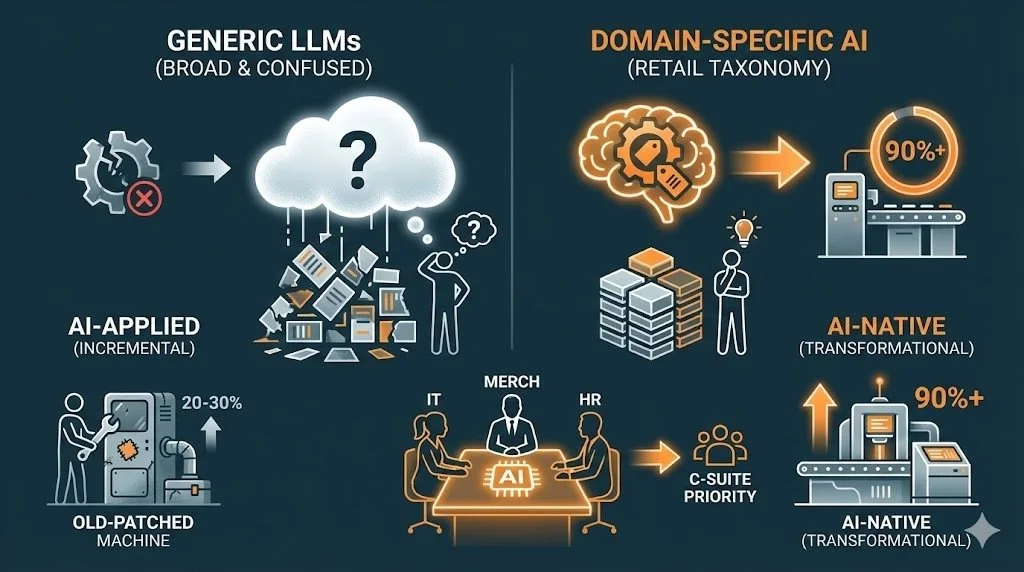
AI-native solutions can deliver 90% efficiency gains in processes like product information management – impossible with iterative improvements to legacy systems that top out at 20-30%.
The "dirty data" excuse is often wrong. Most retailers have real data that just lacks proper taxonomy and structure, which domain-specific small language models can now interpret.
AI strategy must live at the C-suite level with cross-functional teams, but scaling requires HR involvement. The people change is as significant as the technology change.
AI-native versus AI-applied is the strategic fork in the road. Philippe Schaus, who ran Moët Hennessy and LVMH, draws the distinction clearly: you can bolt AI onto existing processes to get incremental improvements, or you can reimagine processes from the ground up with AI-native approaches. Both paths create value. But only one path can get you 90% efficiency gains.
The example that crystallizes this: product information management in a multi-brand retailer. The traditional process of setting up, enriching, and publishing product data involves multiple handoffs across merchandising, marketing, and operations. It's slow and error-prone.
An AI-applied approach might automate parts of that workflow, perhaps auto-generating descriptions or suggesting categories. You'd get maybe 20-30% efficiency gains.
An AI-native approach ingests data from any source, structures it automatically, and maintains consistency across the entire product lifecycle. Verneek claims 90%+ cost reduction in that process.
The point isn't the specific number. It's that transformational gains require transformational approaches.
Domain-specific AI beats generic LLMs for retail use cases. Karenann Terrell, who was CIO at Walmart and CTO at GSK, makes the case for what she calls "vertical AI" and small language models trained on retail-specific taxonomy.
The argument is practical: retail has store-level language that's consistent whether you're selling footwear, jewelry, or furniture. A small language model that understands that taxonomy can make sense of imperfect data that would confuse a generic system.
This reframes the "data quality" conversation. Terrell pushes back on the excuse that companies can't adopt AI because their data is too dirty: "Organizations don't have dirty data. They have real data that's come off their POS, their websites. What they don't have is a really clear taxonomy and framework around which their data is ingested to be meaningful."
In the old discrete technology world, you needed perfect data. In the LLM world, you need models that understand your business context.
Cross-functional ownership isn't optional, but culture determines structure. Where should AI strategy live? The panel agrees it needs C-suite sponsorship and cross-functional execution, but the specific structure depends on company culture. Terrell makes a provocative point: "These are the truly uninformed for the most part," referring to HR functions that are often excluded from AI planning despite massive workforce implications.
Schaus notes that traditional organizational silos – separate IT and digital departments, merchandising systems walled off from store associates – actively prevent AI from delivering its potential. The data that powers AI shouldn't be the "property" of one function. When a merchant, supply chain planner, and frontline associate can all access the same product information with AI assistance, that's when the silo-breaking creates real value.
What to do about this:
→ Categorize your AI initiatives as AI-native or AI-applied. For each project, ask: Are we optimizing an existing process or reimagining it? AI-applied projects should target 20-30% improvement; AI-native projects should target 80%+ or you're not thinking big enough.
→ Evaluate AI vendors on domain expertise, not just model capability. When assessing retail AI solutions, ask: Does this platform understand retail taxonomy? Can it handle our data without requiring a multi-month cleanup project first? The answer separates tools built for retail from generic AI with a retail skin.
→ Bring HR into AI strategy planning now. If your AI governance doesn't include people leadership, you're designing for proof-of-concept, not scale. The workforce implications of 90% efficiency gains require proactive planning (reskilling, redeployment, or reduction).
Disclaimer
This newsletter is for informational purposes only and summarizes public sources and podcast discussions at a high level. It is not legal, financial, tax, security, or implementation advice, and it does not endorse any product, vendor, or approach. Retail environments, laws, and technologies change quickly; details may be incomplete or out of date. Always validate requirements, security, data protection, labor, and accessibility implications for your organization, and consult qualified advisors before making decisions or changes. All trademarks and brands are the property of their respective owners.
