
AI Won’t Fix Retail (Your Foundation Will)
Welcome to DX Brief - Retail, where every week, we distill industry podcasts and conferences into what you need to know.
In today's issue:
A retailer, brand, and integrator perspective on bringing pilots into production
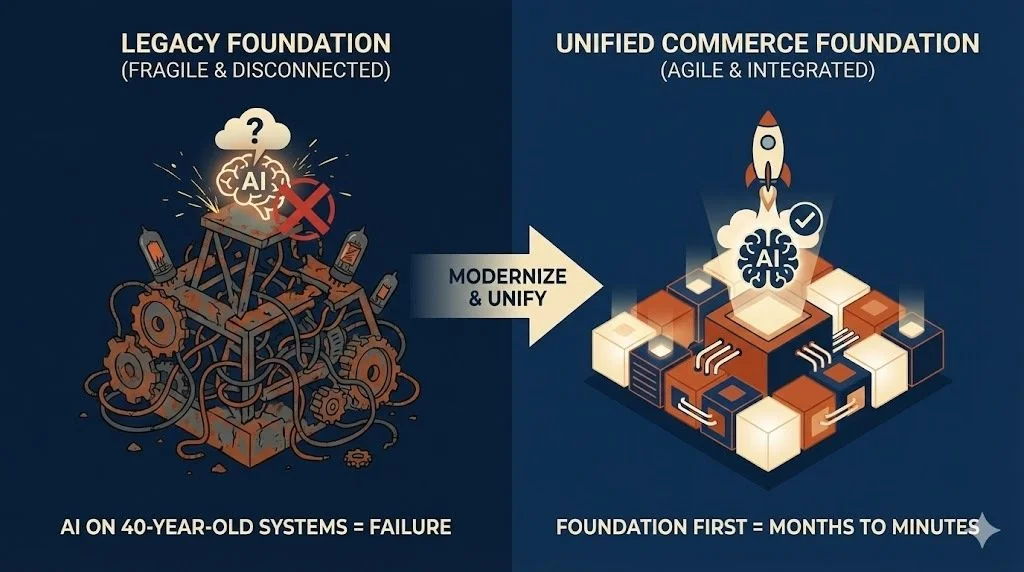
AI deployments on top of 40-year-old legacy systems don’t work
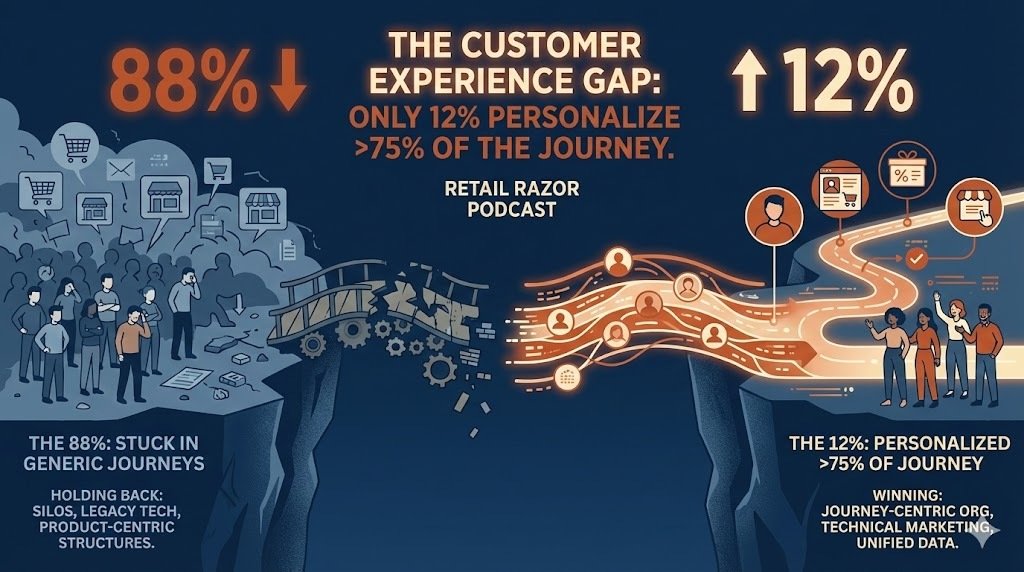
Only 12% of retailers have personalized >75% of the customer journey – what's holding back the rest?
1. A retailer, brand, and integrator perspective on bringing pilots into production
RETHINK Retail podcast: How AI is reshaping retail and CPG operations featuring Brad Tucker ex-Nordstrom, Shashank Kadetotad from Mars, and Debraj Bhattacharya from HCLTech (Feb 20, 2026)
TLDR:
Nordstrom's AI strategy isn't about building new capabilities. It's about giving personal shoppers "thousands of recommendations" to curate from instead of manually searching, enhancing human judgment rather than replacing it.
Mars launched an AI avatar of football coach José Mourinho that responds in his signature sarcastic style as part of a Snickers campaign. Brand recall through AI-powered engagement is real.
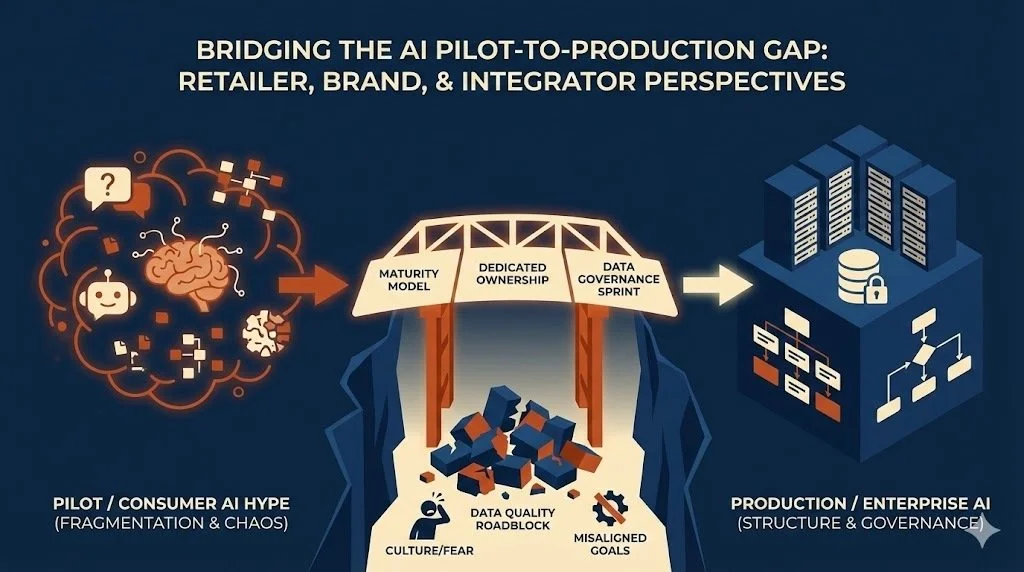
The biggest implementation roadblock across all three perspectives: data quality and governance. Without findable, accurate, governed data that both humans and machines can access, AI initiatives stall.
AI maturity follows the same curve as cloud – learn from that history. Brad Tucker from Nordstrom draws a direct parallel to cloud adoption over the past decade. Early cloud migration involved manually building EC2 instances and migrating servers. Then came containerization, Kubernetes, and shared compute optimization. The same maturity curve is playing out with AI.
Most retailers are at the "manually building pipelines" stage. The next maturity level will be: working with vendor solutions that handle infrastructure so internal teams can focus on applications. This is coming but only for organizations that recognize they've "learned enough themselves" to graduate from custom builds.
The lesson: don't over-engineer early AI implementations. What you build today won't match your maturity level in two years. Accept that and design for iteration rather than permanence.
The Chief AI Officer debate reveals a deeper truth about organizational readiness. The panel split 2-1 on whether retailers need a dedicated Chief AI Officer. Tucker argued against it, suggesting the real focus should be "bringing that skill set up for product owners, business buyers, procurement" – democratizing AI capability rather than concentrating it. Shashank disagreed, arguing that a CAIO can "ground" the organization and prevent teams from "giving into the hype."
The disagreement points to something more important than reporting structure: organizations need someone (or some function) responsible for bridging the gap between consumer AI tools and enterprise implementation. The AI landscape for the general public is "super fast evolving with a ton of tools," but the enterprise picture has "a significant gap." Someone has to own that translation.
Three roadblocks appear consistently across retailer, brand, and integrator perspectives. Shashank named the three obstacles he encounters daily at Mars:
First, data quality: "people oversimplify or don't really understand the criticality of having good, high-quality, governed data that's findable and accurate by both machines and humans."
Second, mindset and culture: specifically the fear that "AI is here to replace versus help" and the challenge of managing hype cycles.
Third, upskilling and process redesign: not just training people on tools, but fundamentally rethinking what workflows look like when AI is embedded.
Debraj from HCL added a fourth: the mismatch between business goals and AI applications. "AI for the sake of AI or technology for the sake of technology doesn't make sense unless it ties into a very discrete business end goal."
What to do about this:
→ Apply the cloud maturity model to your AI roadmap. Map where your organization sits on the build-versus-buy spectrum. If you're still manually constructing AI pipelines, ask whether it's time to graduate to platform solutions that let your team focus on applications.
→ Assign ownership for the consumer-to-enterprise AI gap. Whether it's a CAIO, an AI Center of Excellence, or distributed ownership, someone needs to be responsible for translating fast-moving consumer AI tools into enterprise-ready solutions. The gap is real and growing.
→ Run a data governance sprint before your next AI pilot. The panel consensus is clear: data quality is the foundation. Before launching another AI initiative, invest 30-60 days in auditing whether your data is "findable, accurate, and accessible to both machines and humans."
2. AI deployments on top of 40-year-old legacy systems don’t work
Retail Disrupted podcast, Agentic Commerce: Why NCR Voyix Says "Months To Minutes" Is The New Standard w/ Amit Achara from NCR Voyix (Feb 19, 2026)
TLDR:
Amit Achara, Corporate VP of Product and Design at NCR Voyix, has seen retailers attempt agentic AI deployments on top of 40-year-old systems. It doesn't work.
What works? Build unified commerce foundations first, decompose monolithic applications into microservices, then layer agentic capabilities on top.
The result? Deployment cycles that used to take 9-12 months now happen in minutes. The "months to minutes" standard is real: modular microservices architecture allows retailers to deploy changes in hours
Foundation first, agentic AI second. That foundation means a unified commerce platform with a single source of truth – central customer database, transaction database, catalog, pricing.
"A lot of disruption today that we hear in the market is about having siloed systems. Having a unified commerce platform allows you to then unify all the silos from a technology standpoint, from a data standpoint, from an operating model standpoint. Once you have that, then leveraging any tools and technology where agentic commerce plays a key role becomes a much easier gap to fill versus starting from scratch."
Break the monolith into Lego blocks. Traditional point-of-sale systems bundled everything – tax calculation, penny rounding, loyalty, payments – into one massive application. Upgrading meant upgrading everything. That architecture makes 9-12 month deployment cycles inevitable.
The alternative: decompose into small microservices that can be deployed independently. "Why does Lego work with pretty much any structure that we build? Because they are very standard. They have a contract, you know how to plug them in, and you can build whatever you want." These microservices can deploy to cloud or edge devices – the architecture doesn't care.
Edge resilience is non-negotiable. Achara sees this constantly: retail stores in rural areas with choppy network connectivity. Cloud-only architectures fail when the connection drops. "In retail you have to keep these lanes running. The business has to go on."
Unified commerce platforms must support edge deployment. If the network goes down, transactions continue locally, then sync when connectivity returns. This isn't optional architecture; it's the baseline requirement for any serious retail deployment.
Design for three shopper types simultaneously. Achara's research identifies three shopper archetypes that retailers must serve with the same systems:
Necessity shoppers want to get in and get out. They're looking for choice and value with maximum efficiency.
Entertainment shoppers are there for the experience: sampling, browsing, discovering.
Opportunistic shoppers want technology to guide them and prevent mistakes.
Agentic AI becomes valuable when it can identify which type of shopper it's serving and adapt accordingly. The same self-checkout system might nudge one shopper about a forgotten item while accelerating another through a streamlined flow.
Measure adoption, not capability. When asked about measuring product design success, Achara said: "There's a single north star and that is adoption. No matter how amazing an app or tool you may have, if it's not used, if it's not solving somebody's problem, then you haven't done your job as a product leader."
This reframes AI evaluation: don't ask "what can it do?" Ask "is anyone using it?" Track clicks reduced, workflows optimized, time saved. If your AI-powered produce scanner identifies bananas in top-three results, that's a measurable improvement. If it doesn't, capability is irrelevant.
What to do about this:
→ Assess your "agility quotient" before any AI investment. Audit your current tech stack: How long does it take to deploy a simple UX change to self-checkout terminals? If the answer is months, fix that before adding agentic AI.
→ Create a unified commerce migration blueprint. Identify your current silos (customer data, transactions, catalog, pricing). Map the path to a single source of truth. Prioritize based on which unification unlocks the most valuable AI use cases.
→ Implement adoption tracking for every AI deployment. Before launching any agentic AI feature, define the adoption metrics you'll track. Clicks reduced? Time saved? Workflows automated? If you can't measure adoption, you can't prove value.
3. Only 12% of retailers have personalized >75% of the customer journey – what's holding back the rest?
Retail Razor podcast: The Customer Experience Gap Nobody's Talking About (Feb 19, 2026)
The headline: Despite years of investment in personalization, only 12% of retail organizations have personalized more than 75% of the customer journey, and in CPG it's just 8%. Dave Weinand, co-founder and Chief Customer Officer of Incisiv, unpacks the Adobe-Incisiv research across nine industries and ten geographies to reveal why traditional marketing playbooks are failing and what restructuring looks like for the organizations that are winning.
TLDR:
Consumer expectations are now set by Netflix, Uber, and Amazon regardless of industry. Your customer experience competition isn't the retailer next door, it's whoever delivered their last great digital experience.
Marketing has shifted from cost center to revenue engine: 95% of retail marketing leaders are now expected to directly contribute to revenue, yet only 10% of retailers are structured around the customer journey despite 20% saying it's their ideal.
Best Buy restructured from product categories to customer journey stages (discovery, shopping, purchase) and eliminated channel-specific P&Ls. Their success in a "tough segment" proves it's possible.
Your customer experience competition isn't your industry competition. Weinand emphasizes a point Incisiv has been making since 2017: "Consumers don't experience brand in silos... they look at their overall experience regardless of type of company." When your customer gets a great experience from Uber, that becomes their baseline expectation for your checkout flow.
This isn't just theoretical. The research shows 98% of customers abandon carts if checkout takes too many steps, and 92% cite slow page loads as deal breakers. The organizations setting those benchmarks aren't your retail competitors. They're the best digital experiences across every industry your customer touches.
The implication: stop benchmarking against retail peers and start benchmarking against the best digital experiences your customers encounter anywhere.
The restructuring gap is real, and Best Buy shows it can close. Only 10% of retailers are structured around the customer journey, despite 20% saying it's their ideal. In CPG, 33% say organizing by customer segment is ideal, but only 20% have done it. The gap comes from "decades of organizational muscle memory" and the political difficulty of unwinding how organizations budget and measure success.
But Best Buy proves it's achievable. They reorganized from product categories to customer journey stages. Teams now focus on discovery, shopping, and purchase rather than TVs or appliances. They eliminated channel-specific P&Ls and measure around customer lifetime value instead. The result: strong performance in consumer electronics, a segment where competitors like Circuit City disappeared entirely.
Sephora offers another model, organizing their "buyer journey as a beauty journey" focused on discovery, inspiration, trial, and education. Their Beauty Insider program serves as the "organizing principle" for the entire customer relationship.
Marketing is no longer a cost center – act like a revenue engine. The research shows 95% of retail marketing leaders are now expected to directly contribute to revenue, and 79% say marketing owns more of the customer experience than ever before. "Vanity metrics" like reach, impressions, and influencer penetration "just aren't going to hold water" anymore.
This creates a new competency requirement: marketers need to understand data science, behavioral psychology, and technical implementation, not just creative storytelling.
"Technical marketing" is emerging as a distinct role: marketers who can write SQL queries, run A/B tests, and build predictive models. Weinand frames it as "the art of marketing equally blended with the science of marketing."
The organizations adapting fastest are giving smaller teams more autonomous decision-making authority and shifting from "big campaigns with three-month check-ins" to continuous testing with rapid iteration.
What to do about this:
→ Benchmark customer experience against your customers' best digital experiences, not your industry. Identify the top 5 digital experiences your customers love (streaming, rideshare, delivery apps) and audit your journey against those standards, not retail peer sets.
→ Study the Best Buy restructuring playbook. Document how they moved from product-centric to journey-centric org structure and eliminated channel-specific P&Ls. Identify which elements are transferable to your organization and which require adaptation.
→ Hire or develop technical marketers. If your marketing team can't write queries, run controlled tests, or interpret predictive models, you have a capability gap. Either upskill existing team members or bring in hybrid talent who bridge creative and analytical disciplines.
Disclaimer
This newsletter is for informational purposes only and summarizes public sources and podcast discussions at a high level. It is not legal, financial, tax, security, or implementation advice, and it does not endorse any product, vendor, or approach. Retail environments, laws, and technologies change quickly; details may be incomplete or out of date. Always validate requirements, security, data protection, labor, and accessibility implications for your organization, and consult qualified advisors before making decisions or changes. All trademarks and brands are the property of their respective owners.
